Toddler Tantrum in the Store: What I Do Instead of Buying It
Our local supermarket starts with a section of kids’ clothing. My 4-year-old is in the phase of admiring Paw Patrol, so, of course, he is drawn to the racks of colorful Paw Patrol shirts, or pants, or hats, or anything related to the pups. You thought you were going grocery shopping? But no. Before I start, I need to prevent a tantrum and convince my Paw Patrol fashion lover that he doesn’t need a 10th T-shirt with Marshall.
Practice makes perfect, and I finally found a solution that works better for me than arguing or giving in. I’m a mom, not a child psychologist, but I looked into the research, and it helps explain why this works. I’ll share it later in this post.
Step 1: Show him what he already has
Telling him that he already has a lot of Paw Patrol clothes, that I don’t have money for all his wishes, or that we have no time — this doesn’t work. He is an emotional toddler who wants something he sees here and now.
So I use the screen as my secret weapon. I take out my phone and open KidCloset, the app where I keep track of my kids’ clothes. I filter by the Paw Patrol tag and show him every Paw Patrol piece he already owns.
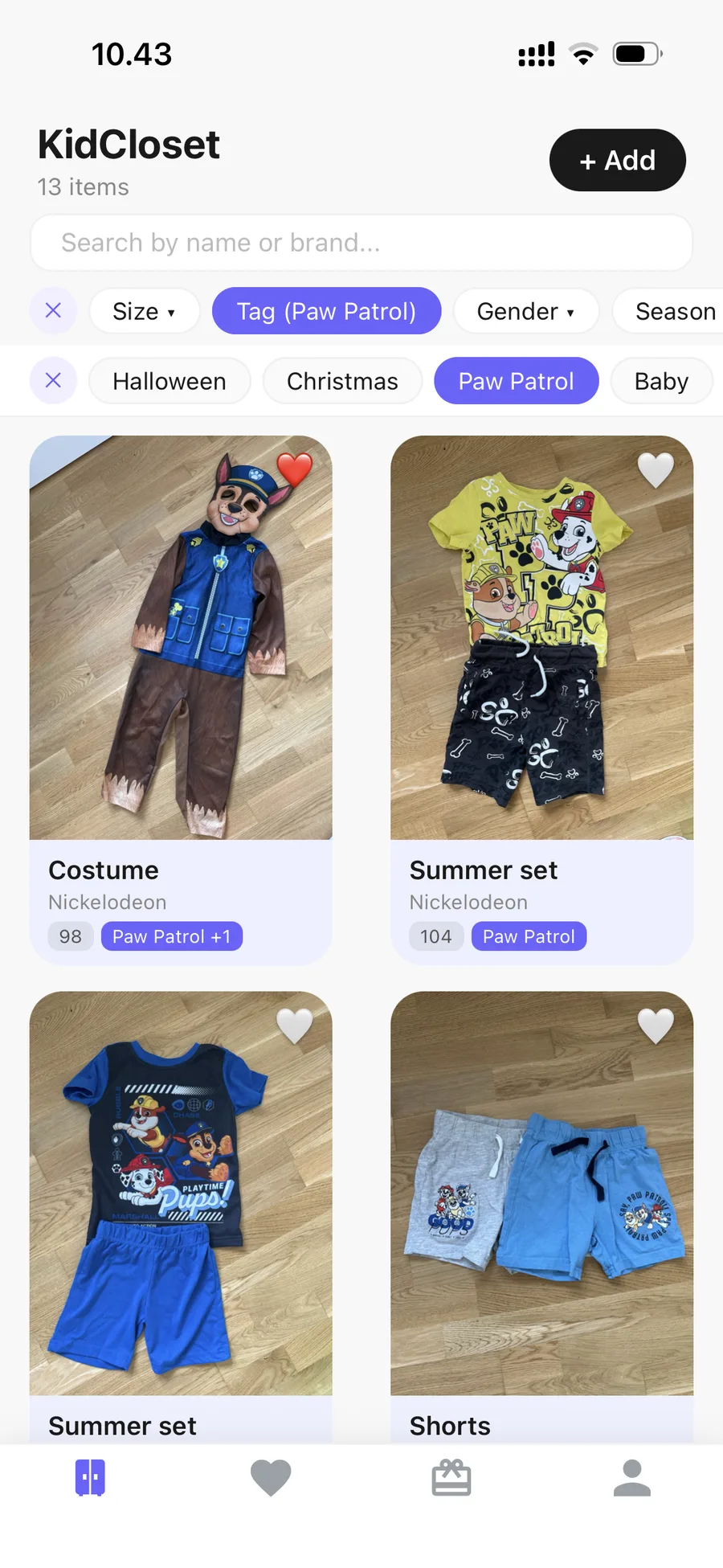
This switches his attention instantly. Screens are a kind of magic for toddlers, and suddenly he’s looking at his own things instead of the shelf.
Step 2: Tell the stories and revive memories
After I get his attention, we go through his favorite items on the screen. And I start telling him stories, like this:
“Remember this shirt? Grandma gave it to you the last time she visited. You wore it to børnehave (kindergarten), and everybody loved it!”
“These pajamas were your brother’s. Do you want me to get them out for you?” (This works like a charm. He loves his older brother and everything that belongs or belonged to him.)
“And this is your Halloween costume. Are you wearing it again this year? Yeah? By the way, it’s pumpkin season. Do you want to go and grab a pumpkin?”
Step 3: Move on!
By the end, he’s telling me the stories himself, and we’re on to the next thing, usually our grocery list.
What research says about why this can help
I wanted to know if this was just luck, so I looked at the research on toddlers. Here is what I found, in plain language.
Giving toddlers something else to engage with. In a 1996 lab study of 37 two-year-olds, researchers watched how toddlers handled mildly stressful situations like waiting. Actively engaging with something was the strategy they used most, and it was the one most linked to lower distress (Grolnick, Bridges & Connell, 1996). My son is older now, but the idea is the same. That study looked at what toddlers do themselves, not at parents redirecting them, so I see it as support for the idea rather than proof.
Talking about shared memories. When parents talk about the past with young children in a detailed, emotional, collaborative way, researchers call it elaborative reminiscing. It is linked to stronger autobiographical memory, and to benefits for language and social-emotional skills (Salmon & Reese, 2016). Asking “remember when Grandma gave you this?” is exactly that kind of conversation.
Why tantrums can feel so fast. A study of 335 children aged 18 to 60 months found that anger tends to peak at or near the start of a tantrum and then fade, while crying and comfort-seeking slowly rise. Most tantrums were short: 75% lasted five minutes or less (Potegal, Kosorok & Davidson, 2003). Based on my own experience, I find it easier to redirect early, but that is my experience, not a finding from the study.
None of this promises that a tantrum will stop. Every child is different, and some days nothing works.
Try it with toys, books, and everything else
This is not only about clothes. If you keep a record of your child’s things in one place, whether that’s clothes, shoes, toys, books, or Lego sets, you can use it the same way. Show them what they already have, tell the story behind it, and move on.
It also helps you. When you can see what’s already at home, you don’t buy the same thing twice.
When it doesn’t work
Sometimes the tantrum is too big, and that’s okay. Then I stay calm, keep my toddler safe, and wait it out. Redirecting isn’t a magic trick. It’s one more tool, and it works best when we’re both still able to listen.
Keep track of everything they own
KidCloset helps you remember what your kids already own, so you stop buying what you already have. Free to download.
Sources
- Grolnick, W. S., Bridges, L. J., & Connell, J. P. (1996). Emotion regulation in two-year-olds: Strategies and emotional expression in four contexts. Child Development, 67(3), 928–941.
- Potegal, M., Kosorok, M. R., & Davidson, R. J. (2003). Temper tantrums in young children: 2. Tantrum duration and temporal organization. Journal of Developmental & Behavioral Pediatrics, 24(3), 148–154.
- Salmon, K., & Reese, E. (2016). The benefits of reminiscing with young children. Current Directions in Psychological Science, 25(4), 233–238. https://doi.org/10.1177/0963721416655100