Back to School Preparation for a Preschooler: How I Prepare My 4-Year-Old's Wardrobe for the New Season
My 4-year-old son goes to a Danish børnehave (kindergarten). In Denmark, children start børnehave at the age of 2 years and 10 months, and stay there until 6. This is what in the US will probably be preschool and pre-k. After three weeks of summer holiday in July, børnehave starts again at the beginning of August. For him, there's no new classroom, no new teacher nerves, no pencil case to buy. But there is a wardrobe to prepare, and that part is entirely on me.
This is a different kind of preparation than what I do for my older son. At four, he can't reliably tell me if his shoes hurt. He doesn't notice if his rain jacket is too small. He's too busy with puddles, mud, and whatever fascinating thing he found on the ground to think about clothes. So I think about it for him.
Here's how I do it.
Step 1: Measure first — especially his feet
Since it is still summer, my preparation for the next school season doesn't start until early or even mid-August. Most of the clothes that he used during the summer holiday can still be used in børnehave in August.
My preparation starts with measuring. Height first, because European children's clothing sizes correspond to the child's height in centimetres. Right now he's about 102 cm (about 3'4" / 40 in), which means he's transitioning from size 98 to size 104 (approx. US size 3T to 4T–5T).
Shoe size gets extra attention at this age. A four-year-old will tell you his shoes are perfectly fine — especially if they light up or have a dinosaur on them. He genuinely does not notice that his feet have grown. But ill-fitting shoes at this age affect foot development, so I don't take his word for it. I measure his feet in centimetres and compare against the actual shoe, not just the size on the label, because sizing can vary between brands.
As an experienced mom, I also know that it is not only the length of his foot that matters but also the width. Some brands have shoes for narrow feet, while some are known for wider feet. As boys grow, their feet tend to become narrower, but this is not the case yet for my boy 🙂
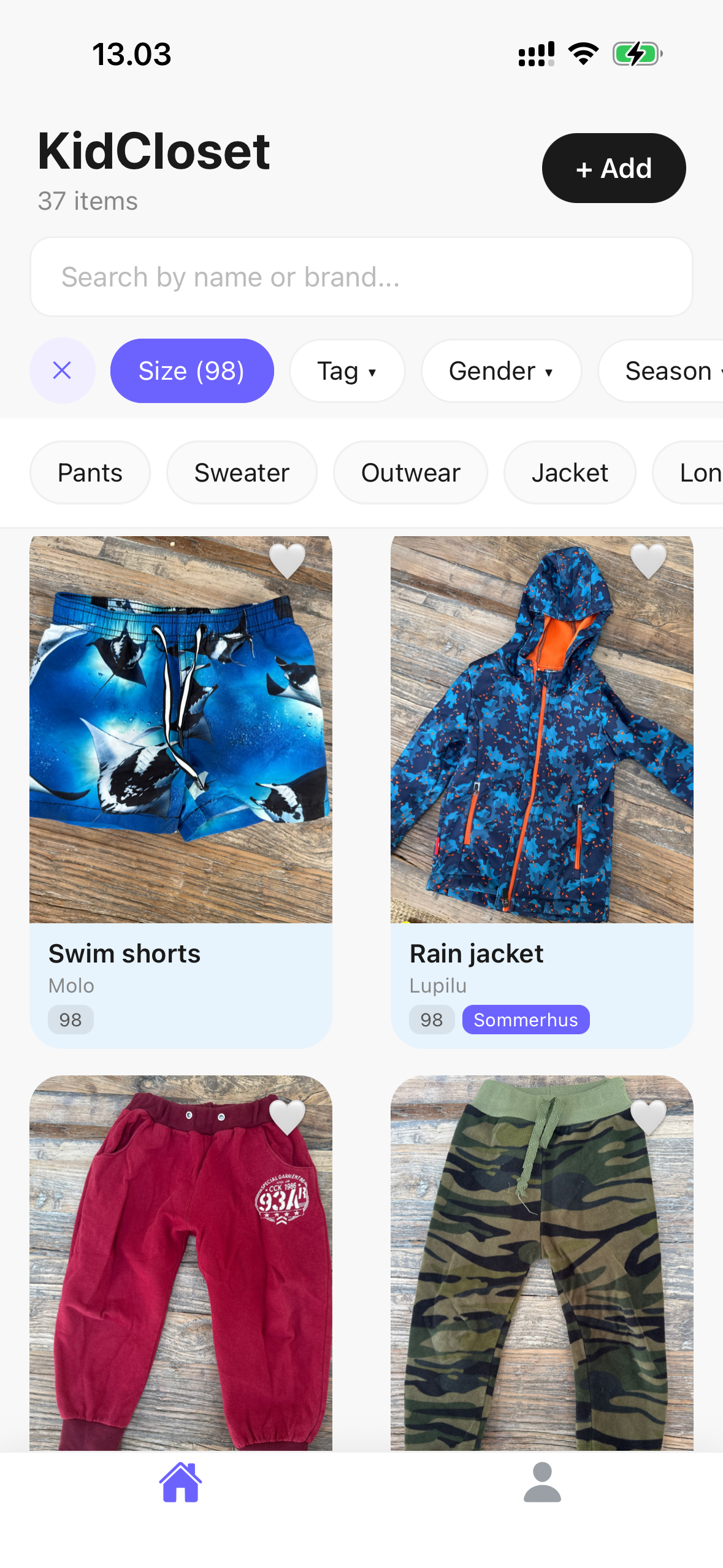
Step 2: Check KidCloset for two sizes and two seasons
He's lucky — or I'm lucky — because he has an older brother. He loves his brother to the moon and back, and when I say that you get to wear your brother's pants, he gets extremely excited. I've kept a lot of clothes from his brother's earlier years, all catalogued in KidCloset, so there's already a lot to work with before I buy anything.
I filter for both sizes 98 and 104 (approx. US 3T and 4T–5T), and I'm looking at two seasons at once: late summer (August is still warm) and autumn, because Danish autumn can arrive without much warning.
Here's what I'm specifically checking for:
- T-shirts
- Shorts (still needed for August)
- Trousers and joggers
- Long-sleeve shirts — not warm ones, just regular long-sleeves for the in-between weather
- Rain jacket and rain trousers — ideally two sets
- Thermo set: jacket and pants — works very well for windy weather
- Flyvedragt (all-in-one outdoor suit) for October/November
- Sneakers and boots
- Winter boots — to have ready when the temperature drops
- Wellies for wet days
The rain clothes, rain boots, and flyvedragt deserve special attention. At børnehave, children spend a significant amount of time outdoors regardless of the weather — which I love — but it means rain gear gets filthy fast. I try to have two full sets so there's always something clean and dry available for the next day.
Step 3: Go through the drawers and storage bins
The app tells me what we own. The drawers and storage bins tell me what's actually usable.
Four-year-olds fall down constantly. They play in mud. They sit in puddles on purpose. Clothes at this age wear out fast — stains that won't come out, trousers with holes in both knees, t-shirts that have seen better days. So I go through his drawers, and I also pull out the storage bins with the next size up — size 104 (approx. US 4T–5T) for clothes, and size 27 (approx. US kids' size 10) for shoes — to see what's there and what condition it's in. Anything damaged or too worn out for børnehave gets removed. What's left is what he can actually wear.
Step 4: Check the helmet
Around this age, many Danish children are already riding scooters and learning to ride bikes. I check his helmet every season — whether it still fits and whether it's in good condition. Kids are not careful with helmets, so a helmet that no longer fits or has visible damage needs replacing before the season starts.
Step 5: Plan for extras — børnehave needs a spare set
At børnehave, you need to keep several extra sets of clothes at daycare. If he gets soaked or muddy, the staff change him into the spare set. So when I count t-shirts, I'm not counting five for the week — I'm counting five plus one that stays at børnehave plus one that goes in his bag for outings. Same for trousers, underwear, socks, and so on.
Step 6: Build the wishlist — and shop with his personality in mind
Once I've checked the app and gone through the drawers, I know exactly what's missing. Everything goes on a wishlist in KidCloset.
At four, I still buy his clothes myself without consulting him the way I do with my ten-year-old. But I keep his personality in mind. He likes Minecraft, and he will be happy to wear a shirt with Minecraft on it. He loves blinking sneakers. His older brother hates anything with buttons; he actually likes buttons. These things matter when you're shopping for a child who can't tell you what he wants but will tell you very clearly what he won't wear.
One note on shoes from hand-me-downs: even when I have a pair in the right size from his brother, I usually buy at least one new pair. Hand-me-down shoes wear to the shape of the previous child's foot, and they often look worn out. I want him to have something presentable for when we visit people or go into the city — børnehave shoes and going-out shoes are two different things. And if one pair gets destroyed, I will have a new pair available immediately.
A quick check for winter
October and November in Denmark come fast, and they bring cold. While I have his wardrobe sorted for summer and autumn, I also take a quick look at whether he has a flyvedragt and boots for when it gets wet and cold. These don't need to be fully sorted in August, but I want to know what's coming so I'm not scrambling when the first cold week hits.
That's it
Preparing a preschooler's wardrobe is more layered than it looks — two sizes, two seasons, spare sets for børnehave, pass-down shoes to evaluate, a helmet to check. But once you have a system, it takes a couple of hours spread across a few days in August.
The measuring takes five minutes. KidCloset tells me what we have in seconds. Going through the drawers and bins is the longest part. The wishlist builds itself from there.
Try KidCloset
Track your kids' wardrobe, build wishlists, and shop with a purpose.