Back to School in Denmark: How I Prepare My 10-Year-Old's Wardrobe for the New School Year
We live in Denmark, and here school typically starts in mid-August. One thing I genuinely love about the Danish public school system: you don't need to buy much. No textbooks, no notebooks, just some supplies, but everything is provided at school. So when I sit down to plan back to school, I'm really mostly thinking about clothes and shoes. That's what this post is about.
My son is ten years old and just started fourth grade. He's active, he plays football, he's outside with his friends as much as possible, and he does not know that he should take care of his clothes, be careful, or keep things tidy 🙂 Basically, normal boy behavior. Which means this part is entirely on me.
Here's how I prepare his wardrobe for the next school season.
Step 1: Get out the measuring tape
Before I look in any drawer, I measure him. Height and foot length — both.
Height first, because European children's clothing sizes are based on height in centimetres. Last year he was 146 cm (about 4'9" / 57.5 in). This August I measured him at 150 cm (about 4'11" / 59 in), which means he's right in the middle of a transition — outgrowing size 146 (approx. US size 10–12), but not fully into 152 yet (approx. US size 12–14). That changes how I shop entirely, and I'll come back to that in the next step.
Foot length matters just as much, and maybe more. You'd think a ten-year-old would notice if his shoes were too small — but he doesn't. When he's out with his friends, excited, running around, he genuinely does not register that his feet hurt. I've learned not to trust his self-reporting on this. I measure his feet myself, in centimetres, and I use that number when shopping — not just his usual shoe size — because sizing can vary between brands. Sometimes, a 36 in one brand might fit like a 35 in another. The centimetre measurement removes the guesswork.
Step 2: Check KidCloset for two sizes
This is where I open KidCloset and filter through what he already has.
Because he's in that 146→152 transition (approx. US sizes 10–12 and 12–14), I check both sizes. Some 146 pieces will still fit fine through autumn. Some 152 pieces are already wearable now. I need to see both.
I'm specifically looking at what works for late summer and autumn, roughly now through October or November. I deliberately don't focus on winter clothes at this stage. Why? Because he's growing fast enough that the size he needs in November might be different from what I'd buy today. I'll deal with winter when it's actually approaching.
Here's what I'm checking for this season:
- T-shirts
- Long-sleeve shirts
- Shorts (still needed for August)
- Trousers and joggers
- Hoodies
- Rain jacket (essential in Denmark)
- Rain trousers
- A proper jacket for when it gets colder
- Sneakers — he doesn't wear anything else for school
- Hats / scarves / gloves
Denmark is known for its rainy and windy autumn weather, and it can come early. A good rain jacket isn't optional here — it's part of the weekly uniform.
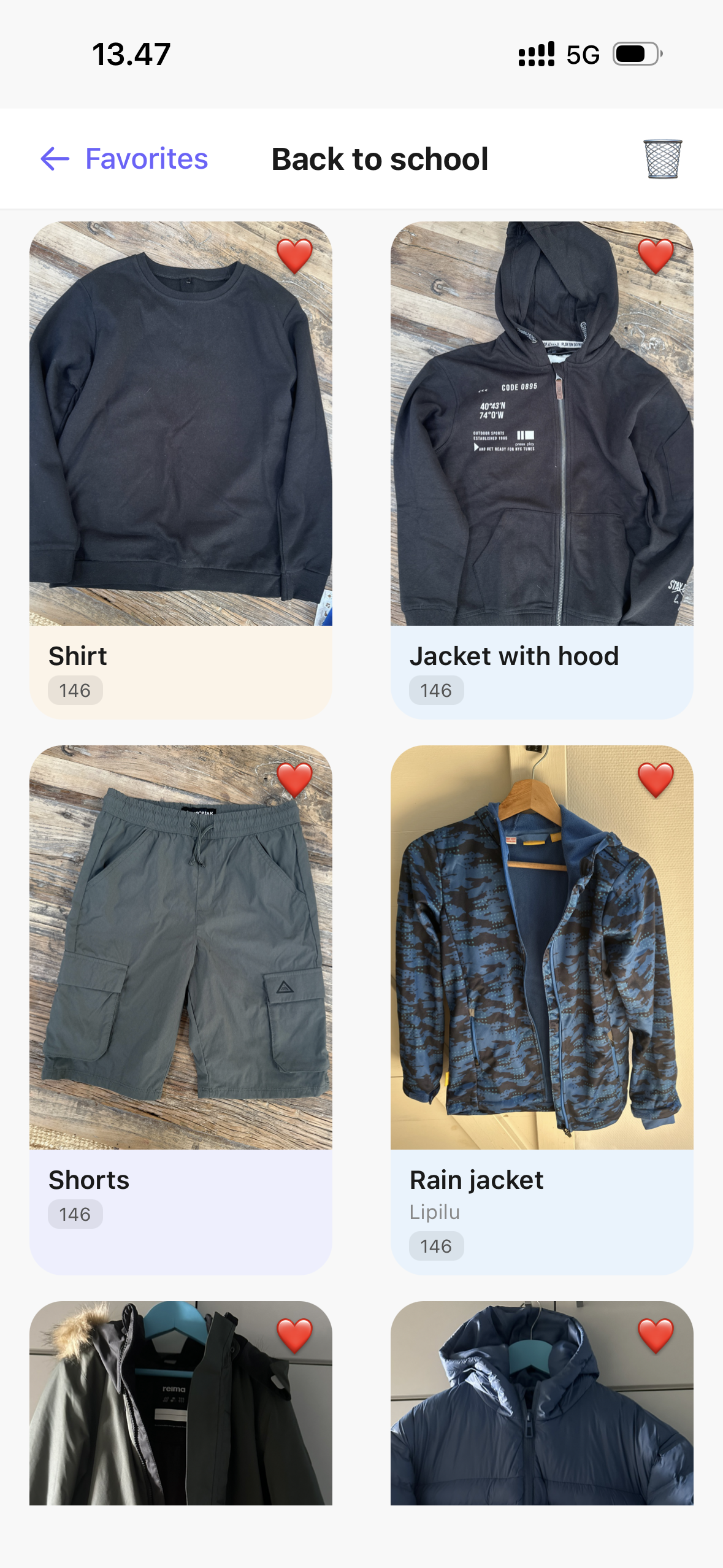
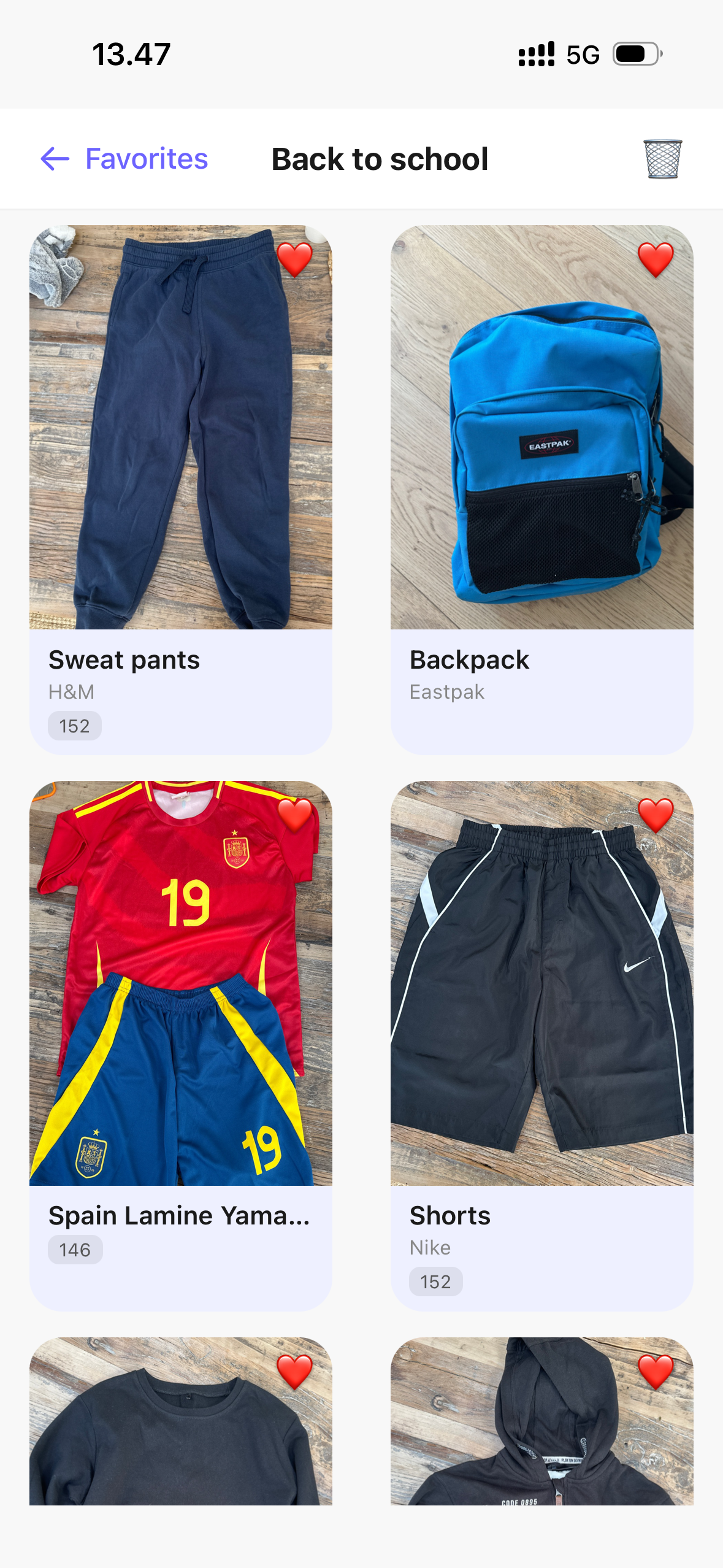
As I go through the app, I also build a new "Back to School" collection in KidCloset. I add the pieces that fit, that are in good condition, and that are ready for the season. By the end of this step, I have a clear picture of what we actually have.
Step 3: Check the drawers by hand
The app tells me what we own. The drawers tell me what's actually wearable.
My son plays football, runs around outside every afternoon, and falls down a lot. Trousers get holes. Shirts get permanently stained. Things get so worn out that they're not really appropriate for school anymore. None of this shows up in KidCloset — I catalogued those items when they were new, not when they became rags.
So I go through his drawers physically. This is the step where I find the hoodie with a broken zipper, the t-shirt that's technically his size but has shrunk so much it sits above his belly button, and the joggers that are somehow stiff and grey despite being washed twenty times.
Anything that's damaged, worn out, or doesn't fit gets pulled out. Now I have a realistic picture of what he can actually wear.
Step 4: Don't forget extracurricular kit
My son plays football for a club, which means he has training sessions on top of school. That kit is my responsibility too.
When I check his drawers, I also check his training clothes specifically: his club training uniform and his football boots. Training kit takes a beating — it gets washed constantly, worn hard, and kids outgrow it on the same schedule as everything else. It's easy to forget until the first training session of the season, which is not the moment you want to discover his boots are two sizes too small.
Step 5: Build the wishlist — and actually ask him
After checking the app and the drawers, I know exactly what's missing. I add the missing pieces to a wishlist in KidCloset before I go anywhere near a shop.
This step has one element I've learned: I ask him.
At ten years old, he has strong opinions. There have been perfectly good t-shirts that he refused to wear because of the color. Shoes I thought were great that he thought were embarrassing. If I shop without consulting him, I risk buying things that sit in his drawer untouched.
So before I go shopping, I show him the wishlist. "You need two new pairs of trousers — what color do you want?" "Your rain jacket is too small — do you want to try a different brand this time?"
Then I go shopping with the list. I try to stick to it. It's tempting to pick up extras when you're in a store and something looks nice. But the whole point of this process is knowing exactly what you need, so extras are just things that will sit unused.
That's it
It sounds like a lot of steps, but in practice this takes me a couple of hours spread across a few days. The measuring takes five minutes. Checking KidCloset takes another five. Going through his drawers — maybe twenty. The wishlist builds itself from those two checks.
The shopping goes much faster and smoother because I already know exactly what I need.
Try KidCloset
Track your kids' wardrobe, build wishlists, and shop with a purpose.